
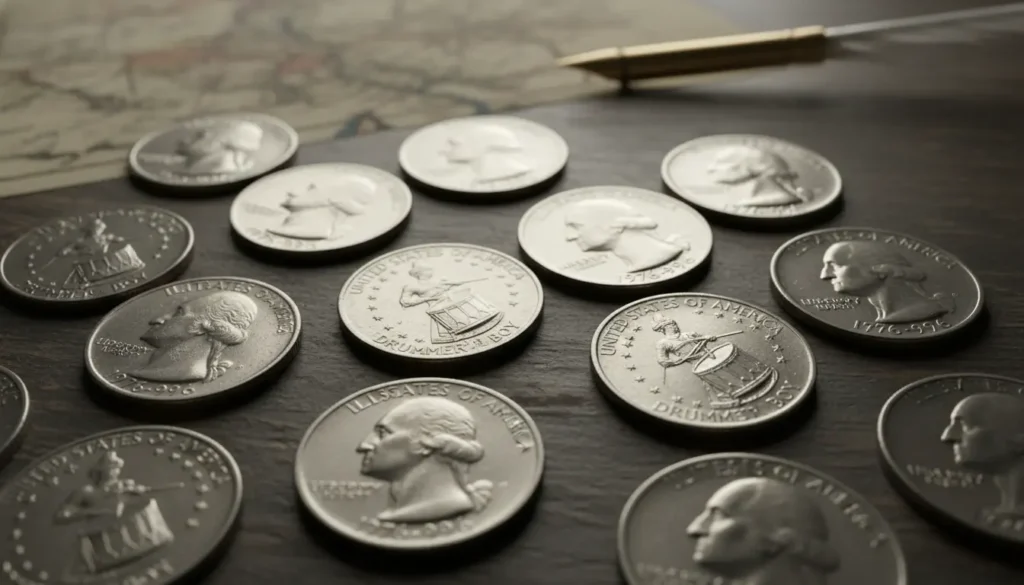
Viral posts sometimes claim that a few Bicentennial quarters in circulation are worth $270 million each. This article explains what those claims mean, what types of Bicentennial quarters can be genuinely valuable, and practical steps to verify and protect a possible find.
8 Rare Bicentennial Quarters: What to Know
When people say “8 rare Bicentennial quarters,” they usually refer to specific error types or exceptionally high-grade coins rather than a fixed list of eight individual coins. The Bicentennial quarter (1776–1976 design) circulated widely, so most pieces are common.
These are eight types of Bicentennial quarters that can be more valuable than face value:
- Off-center strikes — coins struck noticeably off the planchet.
- Double die obverse or reverse — doubled features visible on legends or design elements.
- Wrong planchet strikes — coins struck on planchets intended for other denominations or on silver planchets.
- Clipped planchets and planchet errors — visible missing sections or unusual edges.
- Lamination errors and severe die breaks — surface peeling or large die cuds.
- Proof or special mint errors — defective proof coins from mint sets.
- High-grade mint state coins (MS67+) — exceptionally preserved uncirculated pieces.
- Struck-through debris or unique hand-fed errors — one-off anomalies collectors prize.
Are they worth $270 Million each?
No. Claims that any Bicentennial quarter is worth $270 million each are not credible. Coin values are set by the market: condition, rarity, demand, and verified authentication determine price.
Even dramatic error coins typically sell for thousands to tens of thousands of dollars at auction. Exceptional one-off pieces might reach low six figures in rare cases. A $270 million valuation would be outside any realistic collector market for a single modern quarter.
How coin values are determined
Understanding valuation helps you evaluate viral claims. Four primary factors set a coin’s value:
- Rarity: How many examples of that exact error or grade exist.
- Condition/grade: Numismatic grading scales (MS, PF) dramatically affect price.
- Authentication: Reputable services (PCGS, NGC) verify and grade coins.
- Market demand: Interest from collectors and the number of active bidders.
Without strong evidence of rarity and proper graded certification, a sensational headline is not a reliable indicator of value.
How to inspect a Bicentennial quarter you found
Follow a simple checklist to assess a suspicious Bicentennial quarter. Don’t clean or alter the coin — cleaning can destroy value.
- Visual check: Look for obvious errors (off-center, doubling, clipped planchet).
- Use a loupe: 5x–10x magnification helps reveal doubled dies or die cracks.
- Compare: Use online coin guides and auction archives to find similar examples.
- Photograph: Take clear photos of both sides and any notable features.
Keep the coin safe in a soft, inert holder like a Mylar flip or airtight capsule until you can get an expert opinion.
What to do if you think you found one of the 8 rare Bicentennial quarters
If you believe you have a valuable Bicentennial quarter, follow these steps to protect value and get the best outcome:
- Do not clean the coin or handle it more than necessary.
- Document the find: where, when, and how it was discovered.
- Take high-quality photos under good light from multiple angles.
- Search auction records and specialist forums for similar errors.
- Seek a preliminary opinion from a reputable local coin dealer.
- If promising, submit the coin to an independent grading service (PCGS or NGC) for authentication.
- Consider selling via a reputable auction house or dealer with experience in error coins.
The U.S. Mint produced billions of Bicentennial quarters for circulation in 1975–1976. Their wide availability is why most of these coins are common despite occasional valuable errors.
Real-world example: A typical outcome
Example: A shopper found a clearly off-center Bicentennial quarter in their change and saved it. After photographing the coin and consulting a local dealer, they submitted it to a grading service. The piece was confirmed as a significant error and sold at a regional auction for several thousand dollars.
This case shows the usual path: careful handling, authentication, and a targeted sale produce results that reflect the actual market, not viral headline values.
Final tips for collectors and finders
Be skeptical of viral dollar-value claims and focus on verification. Use community resources like coin clubs and established grading companies to confirm worth.
- Never pay upfront fees to list on a platform promising huge payouts.
- Get multiple opinions for unusual or high-value items.
- Keep records and certificates from grading or authentication services.
In short, while there are rare and valuable Bicentennial quarters in circulation, $270 million per coin is not realistic. Careful inspection and proper authentication will tell you the real story and help you get fair market value.