
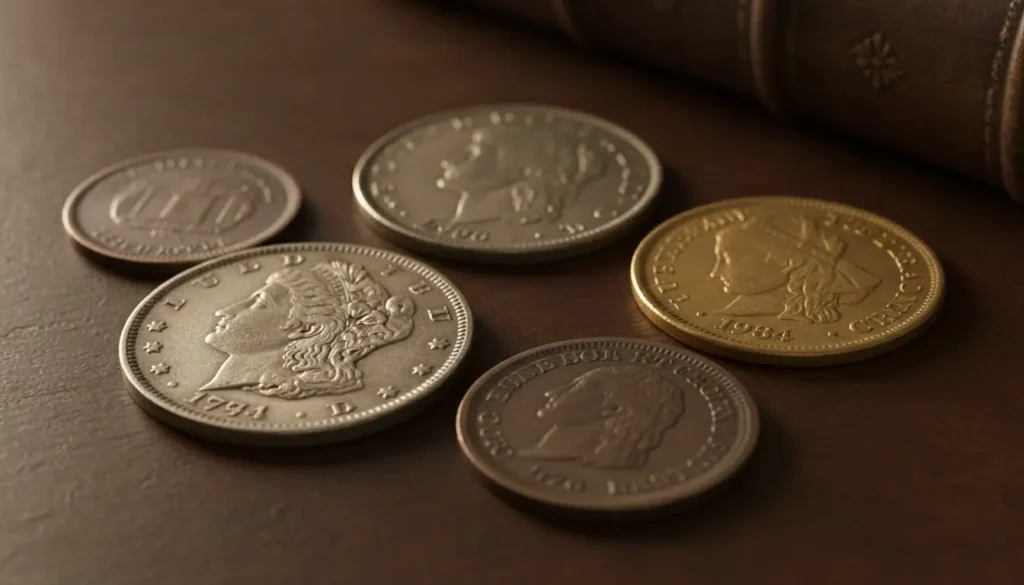
Are there Rare American Coins Worth Over 25 Million?
When people talk about record coin prices, they imagine seven-figure and even eight-figure auction results. Very few American coins ever reach the multi-million-dollar tier, and auctions that break the highest records are exceptional events.
Factors that push a coin into the highest price brackets include extreme rarity, pristine condition, historical significance, and strong provenance. These traits usually apply to early colonial coins, pattern pieces, and unique errors — not modern circulating issues.
Which types of American coins can reach very high prices?
Coins that attract the top dollar typically fall into these groups:
- Colonial era and early federal issues (late 1700s).
- Single-known or very low-quantity pattern and proof coins.
- Major mint error coins with verifiable uniqueness.
- Gold coins with historic provenance tied to important collections.
Is the Bicentennial Quarter One of Them?
The short answer: no. The Bicentennial quarter, struck for the 1975–1976 United States Bicentennial celebration, is not a candidate for multi-million-dollar value under normal circumstances.
Millions of Bicentennial quarters were produced for circulation, plus separate proof and special collector issues. High mintage and wide availability sharply limit the upper market value for ordinary examples.
Why the Bicentennial Quarter is common
Key reasons it does not approach top-tier coin values:
- Very high mintage numbers for business strikes and collector sets.
- No historically unique specimen tied to a formative national event in the way early federal coins are.
- Modern minting controls mean fewer one-of-a-kind errors survive unaltered.
When can a Bicentennial Quarter still be valuable?
That said, some Bicentennial quarters have collector value. The most valuable examples are:
- High-grade proofs from the San Francisco mint (1976-S) in top MS/PR grades.
- Certified pristine business strikes in near-perfect Mint State grades (MS67 and higher).
- Confirmed error coins with documented provenance, such as striking errors or unusual planchet issues.
Even in these categories, values are typically in the low thousands to low tens of thousands of dollars range — far from the multi-million mark.
What makes a coin worth over 25 million?
To reach or exceed a 25 million valuation, a coin normally needs a combination of:
- Historical significance: an early, foundational piece of the nation’s coinage.
- Absolute rarity: very few known examples, sometimes only one.
- Exceptional grade: the surviving specimen is in near-perfect condition.
- Provenance: ownership history from famous collections or important finds.
Examples of high-value U.S. coins that gather intense bidding are colonial gold pieces (like Brasher Doubloons), early silver dollars, and certain pattern coins. These coins come from eras when mint records were sparse and survival rates low.
How condition and certification matter
Modern grading by third-party services (PCGS, NGC) influences market confidence. A verified and high-graded specimen commands higher prices because buyers trust the grade and authenticity.
For Bicentennial quarters, certification can raise price and liquidity, but cannot create the extreme rarity needed to reach tens of millions.
Practical guidance for collectors
If you own or are looking to buy Bicentennial quarters, use these practical steps:
- Get coins graded if they appear to be high-grade proofs or near-perfect business strikes.
- Document any unusual features with clear photos and seek expert opinions for alleged errors.
- Compare recent sales in auction catalogs and specialist dealer listings to set realistic price expectations.
Most Bicentennial quarters were minted in 1975 and 1976 and feature a special two-drum and torch reverse by Jack L. Ahr. The design appears on millions of circulating coins, which is the main reason they are not considered ultra-rare.
Small real-world case study
Case study: A collector inherited a run of circulation Bicentennial quarters and sorted them for potential rarities. They located a handful of proof-like business strikes and one high-grade 1976-S proof in a dealer-proof set.
The collector had the best pieces graded and sold the certified proof and high-grade business strikes to a focused dealer. The total realized value was modest but significantly higher than face value — illustrating that careful grading and targeted marketing increase returns, even when the coin cannot become a multi-million-dollar item.
Example sale considerations
- High-grade certified Bicentennial proof: sold to a specialist dealer or at auction for a premium relative to standard proofs.
- Common business strikes: likely worth face value to a few dollars each unless certified very high grade.
- Error coins: require strong documentation and expert validation to fetch notable prices.
Final takeaway about Rare American Coins Worth Over 25 Million and the Bicentennial Quarter
While some American coins achieve eye-popping prices, the Bicentennial quarter — due to its large mintage and modern production — is not among the coins that reach or exceed 25 million in value.
For collectors, the practical approach is to authenticate and grade any promising Bicentennial pieces, understand realistic value ranges, and focus on rarity and condition when seeking high returns.
If you want, I can review a photo and description of a specific Bicentennial quarter to help determine whether it should be graded or sent to auction.