
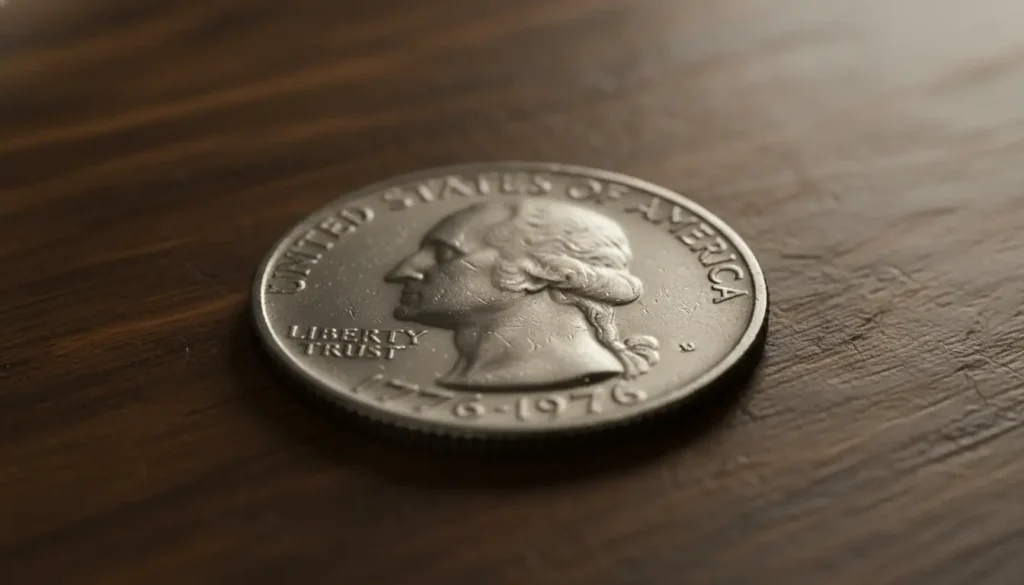
The 1976 Bicentennial quarter is a common coin you might still find in change. Stories about one coin being worth $1 million circulate online, but what makes a Bicentennial quarter truly valuable is specific and verifiable. This article explains how to spot rare Bicentennial quarters, realistic value ranges, and the steps to authenticate and sell a high-value find.
Why the Bicentennial Quarter Is So Common
The Bicentennial quarter was issued in 1975–1976 to celebrate the United States’ 200th anniversary. It features a dual date (1776–1976) and a special reverse design with a colonial drummer. Billions were produced for circulation and proofs, which keeps most examples inexpensive.
Being common does not exclude rare exceptions. Value comes from errors, unusual planchets, proofs with silver content, and extremely high uncirculated grades. Knowing what to look for helps separate ordinary coins from potential rarities.
How to Identify a Rare Bicentennial Quarter
Most high-value Bicentennial quarters fall into a few categories. Carefully inspecting your coin can reveal clues that move it from pocket change to a candidate for professional grading.
Key features to check
- Mint mark: Look for D, S, or no mint mark. San Francisco proofs (S) sometimes exist in 40% silver proof sets.
- Reverse design details: Check the drummer, drumsticks, and date area for doubling or clashes.
- Edge and weight: Errors like clipped planchets, broadstrikes, or wrong-metal planchets matter.
- Surface: Prooflike or deep cameo surfaces, or unusual toning, can raise interest.
Use a loupe (10x magnification) to inspect the coin and compare it against reference images from trusted numismatic sites or auction houses.
Common Rare Varieties and Errors
Here are error types and varieties that collectors prize. Not every example of these error types is worth a huge sum, but documented and certified examples can be valuable.
- Off-center strike — Part of the design is missing because the coin did not sit squarely in the press.
- Broadstrike — The coin spreads on the planchet and appears larger with a flattened rim.
- Clipped planchet — A curved missing section where the blank was cut incorrectly.
- Die break or crack — Raised lines or blobs appear where the die failed.
- Double die — Doubling of lettering, date, or design elements from die misalignment.
- Wrong planchet — A coin struck on a planchet meant for another denomination or composition.
Silver Proof Variants
San Francisco proof Bicentennial quarters struck in silver (part of special proof sets) are composed differently from clad circulation coins and often command higher prices. However, silver proofs are well-documented; only uncommonly preserved or uniquely flawed specimens reach high auction values.
The 1776–1976 date appears on Bicentennial coins that were minted in 1975 and 1976. No U.S. quarters were dated 1975; both years use the dual date 1776–1976.
Steps to Verify a Potentially Valuable Bicentennial Quarter
If you think you have a rare Bicentennial quarter, follow a clear process to verify and preserve value. Rushed decisions often reduce sale prices.
- Document the coin with high-quality photos showing obverse, reverse, edge, and any unusual details.
- Compare images with reference databases from PCGS, NGC, and major auction houses to match known varieties.
- Avoid cleaning the coin. Cleaning often destroys value.
- Have the coin examined by a reputable dealer or numismatist for a preliminary opinion.
- Send the coin to a professional grading service (PCGS or NGC) if it appears rare or highly graded.
Proper grading and certification are essential for achieving top prices at auction because buyers rely on independent authentication.
Realistic Market Expectations
Could a single Bicentennial quarter be worth $1 million? In practice, this is extremely unlikely. Most valuable Bicentennial quarters sell in the hundreds to low tens of thousands range. Only coins with unique provenance, previously unknown mint errors of extraordinary magnitude, or truly one-of-a-kind features approach high six-figure prices in very rare scenarios.
Factors affecting price include rarity, demand, physical condition, and auction exposure. The presence of a verified, previously unknown error and a flawless grade would be required to approach seven-figure valuations.
What to do if you find a potentially valuable coin
- Keep it safe in a soft, inert holder to avoid scratches.
- Gather documentation about where and when you found it.
- Seek multiple opinions from reputable dealers before pursuing grading.
- Study recent auction results for similar error types to set realistic price expectations.
Case Study: A Local Discovery and the Path to Sale
A collector found a Bicentennial quarter in a jar of mixed coins that had an unusual off-center strike covering nearly half the design. After photographing the coin and getting a dealer’s opinion, the collector sent it to a grading service. The coin received a certified designation as an off-center strike with strong eye appeal and later sold at a specialist auction for several thousand dollars.
This example shows how a methodical approach—document, authenticate, grade, and sell through the right channel—turns a surprising find into measurable value.
Final Practical Tips
Keep the expectations realistic and follow a careful verification process. A $1 million Bicentennial quarter is a headline-grabbing idea, but discoverable million-dollar coins require extraordinary, documented uniqueness. For most collectors and finders, the path to value is grading, proper listing, and selling through reputable auction houses or dealers.
If you think you have a rare Bicentennial quarter, document it, avoid cleaning, and consult professionals. That method gives you the best chance of realizing real market value.