
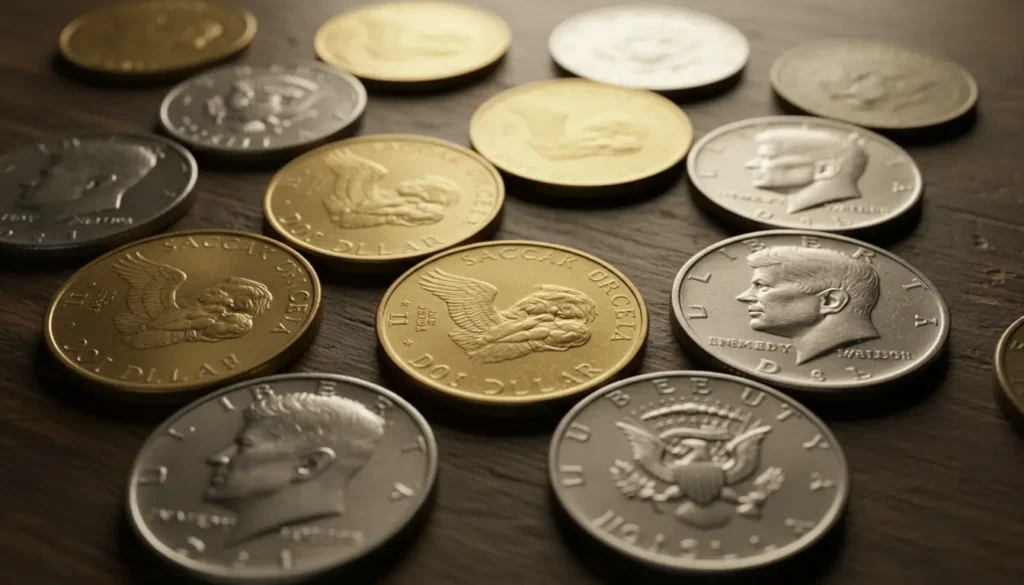
Choosing between a Sacagawea Dollar and a Kennedy Half Dollar comes down to purpose: collecting, gifting, or investing. Each coin has distinct history, metal content, and market demand that affect long-term value and enjoyment.
Sacagawea Dollar vs Kennedy Half Dollar: Quick Overview
The Sacagawea Dollar was introduced in 2000 as a modern dollar coin with a golden color and a native American subject. It is primarily a circulating coin with copper core and manganese-brass cladding.
The Kennedy Half Dollar began in 1964 as a memorial to President Kennedy. Early issues contained silver, and later issues are copper-nickel clad. The half dollar is larger and often collected for its silver content and historical interest.
Key attributes to compare
- Size and weight: Half dollars are larger and heavier than dollar coins.
- Metal content: Some Kennedy halves contain silver; Sacagawea dollars do not.
- Design appeal: Sacagawea has a modern gold-tone look; Kennedy is a classic portrait coin.
- Availability: Sacagawea dollars are common in circulation and sets; many Kennedy halves are harder to find in everyday spending.
Why metal content matters for Sacagawea Dollar vs Kennedy Half Dollar
If you care about intrinsic metal value, the Kennedy Half Dollar often wins. Coins minted in 1964 are 90% silver and later 1965–1970 issues are 40% silver. Those pieces may trade above face value because of silver.
Sacagawea Dollars are clad coins with no precious metal content. Their value is mostly numismatic or sentimental, not melt value. That makes them stable for collectors wanting a modern, low-maintenance piece.
When metal content should decide your choice
- Investment in precious metals: Choose silver Kennedy halves (pre-1971).
- Collecting modern designs or convenience coins: Choose Sacagawea dollars.
- Budget constraints: Sacagawea dollars are inexpensive to acquire in circulated condition.
Condition, rarity, and collector demand
For both coin types, condition (grade) and rarity affect value. Proofs, mint errors, and limited mintages often command premiums. Look for uncirculated examples or certified coins if value appreciation is a goal.
Demand varies: Kennedy halves have a long collector base because of the silver issue and the historical link to JFK. Sacagawea has niche interest tied to modern U.S. coinage and some special releases.
Practical selection checklist
- Decide purpose: display, spending, or investment.
- Set a budget for purchase and grading costs.
- Check year and mint mark for silver content (Kennedy halves) or special issues (Sacagawea dollars).
- Inspect condition or buy certified coins for higher-value pieces.
How to choose the right coin: practical steps
Step 1: Define your goal. If you want a pocket-sized historical piece or silver exposure, lean Kennedy. If you want a modern, durable coin for a daily carry or set, choose Sacagawea.
Step 2: Research specific dates. For example, a 1964 Kennedy half has 90% silver and a clear market. Sacagawea issues to watch include the 2000-P and 2000-D varieties and later Native American reverse changes.
Step 3: Inspect or request certification. Condition drives price. Certified gold labels from reputable services reduce uncertainty for resale.
Buying tips
- Buy from reputable dealers or established auction houses.
- Compare prices online and in local coin shops.
- Avoid raw high-value coins without seeing high-resolution images or a grading report.
The Kennedy Half Dollar was issued just months after President Kennedy’s assassination in 1963, leading to high first-year mintages and strong collector interest in 1964 halves because they contain 90% silver.
Real-world example: Choosing a coin for a starter collection
Case: Maria, a new collector, has a $100 budget to start a U.S. coin collection. She wants variety and potential appreciation, but also coins that look good on display.
Option 1: Buy a mix of circulated Sacagawea dollars and a few Kennedy halves from the 1970s. Pros: visually cohesive set, relatively low cost, and easy to source. Cons: limited silver exposure.
Option 2: Allocate $75 to purchase a certified 1964 Kennedy half (if affordable) or several 1965–1970 40% silver halves, and $25 for a Sacagawea for display. Pros: includes precious metal exposure and modern design. Cons: less quantity of coins.
Outcome: Maria chose Option 2. She acquired a 40% silver Kennedy half in good condition and a Sacagawea Dollar, balancing historical interest with modern appearance and some intrinsic metal value.
Final decision guide
Use this simple rule: choose Kennedy Half Dollars if you want silver or historical depth. Choose Sacagawea Dollars if you want a modern, durable coin for thematic collections or everyday display.
Remember to verify year, mint mark, and grade before buying. Both coins can be rewarding depending on what you value: metal, history, or design.
With clear goals and a bit of research, you can confidently pick the coin that best fits your collecting or gifting plan.