
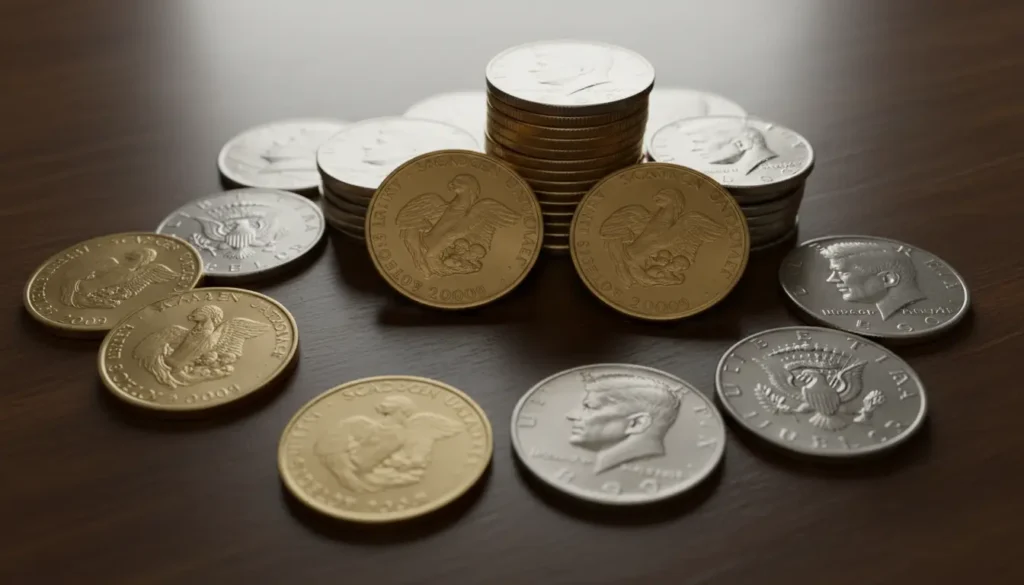
Sacagawea Dollar vs Kennedy Half Dollar: Quick Overview
The Sacagawea dollar and the Kennedy half dollar are two very different U.S. coins with different uses and appeals. Each has unique history, metal composition, size, and collector interest.
Sacagawea Dollar vs Kennedy Half Dollar: Key Differences
Understanding technical differences is the first step in choosing the right coin. Focus on composition, size, face value, and common years to watch.
Composition and appearance
The Sacagawea dollar, introduced in 2000, is a golden-colored coin made of a manganese-brass outer layer bonded to a copper core. It is lighter and smaller than the half dollar.
The Kennedy half dollar debuted in 1964 and has seen changes. Key versions include 1964 (90% silver), 1965-1970 (40% silver), and 1971-present (copper-nickel clad). The half is larger and heavier than the dollar.
Size and weight
Sacagawea dollar: about 26.5 mm diameter and roughly 8.1 grams. Kennedy half dollar: about 30.6 mm diameter and about 11.34 grams for modern clad issues.
Face value and circulation
Sacagawea face value is one dollar, intended for regular circulation though it often circulates rarely. Kennedy half dollar is 50 cents and is more of a collectible in modern times, though older issues circulated widely.
Why collectors and buyers prefer one over the other
Choice depends on collecting goals: low-cost modern sets, silver content, or historical interest. Consider these common motivations.
Collecting set completion
If your goal is to complete modern circulating sets or thematic collections (Native American themes, presidential coins), Sacagawea dollars are practical. They are plentiful in most modern mint and proof varieties.
If you want a classic half-dollar series or silver content, Kennedy halves offer variety including historically important 1964 silver coins and proof issues.
Investment or metal value
For metal value, older Kennedy halves with silver are the clear choice. 1964 examples have significant silver content and intrinsic value tied to silver prices. Sacagawea dollars have little to no precious metal value.
Everyday use and display
Sacagawea dollars are closer to practical use because they are still legal tender at one dollar, lightweight, and visually distinctive. Kennedy halves make stronger display pieces because of size and historical significance.
How to Choose the Right Coin: Practical Checklist
Use this quick checklist to match a coin to your needs. Answer each item honestly for a guide to the right pick.
- Do you want silver metal content? If yes, choose Kennedy halves from 1964 or 1965-1970.
- Are you building modern circulating sets? If yes, Sacagawea dollars are affordable and thematic.
- Is size and display important? Kennedy halves are larger and may present better in albums or frames.
- Are you budget constrained? Modern Sacagawea and circulated Kennedy halves are often inexpensive, but key-date Kennedy halves and mint-state coins can be pricey.
- Do you prefer stories and historical context? Both coins have good stories: Sacagawea honors a Native American guide, Kennedy half commemorates a president.
Sacagawea Dollar vs Kennedy Half Dollar: Real-World Example
Case study: Maria is building a beginner US coin collection on a $200 budget. She wants a visually cohesive set and occasional display pieces.
She bought a roll of circulated Sacagawea dollars for bulk variety and a circulated Kennedy half from the 1970s for display. The Sacagawea dollars filled multiple collection slots cheaply, while the half-dollar added a classic look. She chose not to buy silver 1964 halves because they were above her budget.
Result: Maria created a balanced starter collection with room to upgrade specific pieces later.
Storage, grading, and buying tips
How you store and source coins affects long-term satisfaction and value. Follow these practical guidelines when buying either coin.
- Buy from reputable dealers or well-rated online marketplaces to avoid counterfeits.
- For silver Kennedy halves, consider certified coins for higher-value purchases.
- Store coins in acid-free holders; keep them in a dry, stable environment to prevent toning or corrosion.
- Learn basic grading terms (Good, Fine, Very Fine, Uncirculated) to compare prices and quality.
Sacagawea Dollar vs Kennedy Half Dollar: Final Decision Flow
Use this quick decision flow to finalize your choice. It adapts to common collector profiles.
- If you want silver metal content, choose a 1964 or 1965-70 Kennedy half.
- If you want a modern circulating set or thematic portraits, choose Sacagawea dollars.
- If you prefer larger display coins and historical context, choose Kennedy halves.
- If budget is the primary limit, start with circulated Sacagawea dollars and upgrade to better Kennedy halves later.
The Sacagawea dollar was first issued in 2000 and features Sacagawea carrying her infant, Jean Baptiste. The Kennedy half dollar was introduced in 1964 shortly after President Kennedy’s assassination.
Summary: Which should you choose?
Choose a Sacagawea dollar if you want an affordable, modern, themed coin for circulating sets or display. Choose a Kennedy half dollar if you want larger coins, historical appeal, or silver content in older issues.
Match your choice to your budget, interest in metal content, and how you plan to store or display the coin. Starting small with either coin leaves many upgrade paths as your collecting goals evolve.