
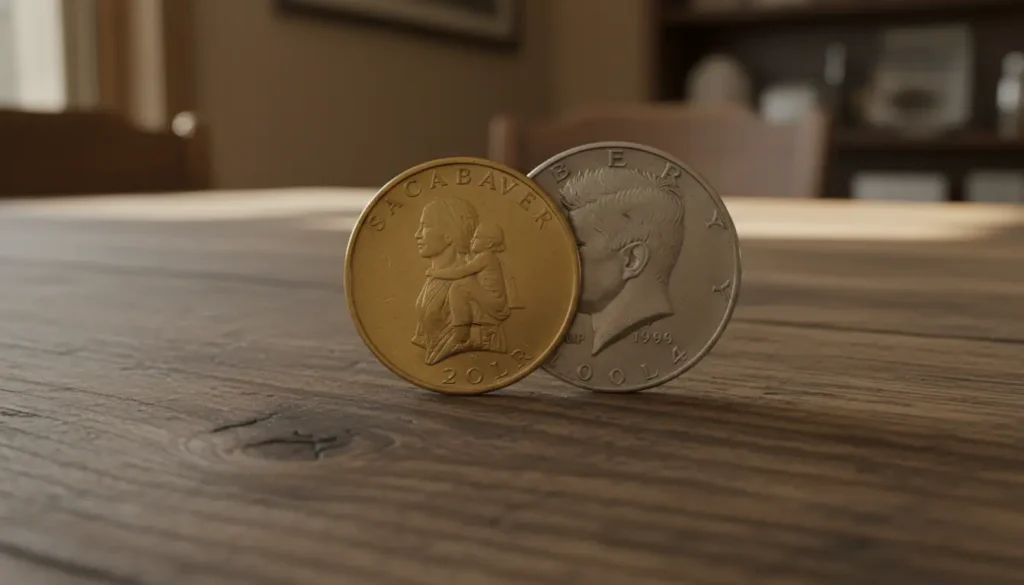
Sacagawea Dollar Vs Kennedy Half Dollar: Quick overview
The Sacagawea dollar and the Kennedy half dollar are two popular U.S. coins with different histories, metals, and collecting audiences.
Choosing the right coin depends on your goal: casual collecting, investment, gifting, or everyday handling. This guide compares core features and gives practical steps to decide.
Design, size, and composition
Sacagawea Dollar: design and makeup
Introduced in 2000, the Sacagawea dollar features a Native American woman carrying her child on the obverse and a variety of reverse designs in later years. It is a one-dollar coin made of a manganese-brass clad, giving it a golden color.
The Sacagawea is smaller in diameter and lighter than a half dollar, and it is intended for easy handling and low production cost.
Kennedy Half Dollar: design and makeup
The Kennedy half dollar debuted in 1964 to honor President John F. Kennedy. Early issues were 90% silver (1964) and later 40% silver (1965–1970). From 1971 onward most circulation halves are copper-nickel clad.
Kennedy halves are larger and heavier than Sacagawea dollars, with strong collector interest in silver and proof issues.
Value and rarity: What to expect
Face value for the Sacagawea is one dollar and for the Kennedy half is fifty cents. Market value depends on metal content, condition, and rarity.
- Sacagawea: Most circulation examples trade near face value unless uncirculated, proof, or rare variety. Special releases and mint errors can raise value.
- Kennedy half: Silver issues (1964; 1965–1970) carry intrinsic bullion value above face. Modern clad halves have modest collector premiums unless in high grade or special strike.
Key dates and special issues
Look for:
- Kennedy 1964 (90% silver) and 1965–1970 (40% silver) for metal value.
- Proof and mint sets for both series that can command higher prices.
- Specific mint errors or low-mintage issues that collectors prize.
How to choose the right coin
Decide by answering practical questions about your goals, budget, and storage plans. Below are concrete criteria to evaluate.
Criteria to compare
- Purpose: Are you collecting for history, investment, or gifts?
- Budget: Do you prefer low-cost entry (modern Sacagawea) or coins with bullion value (silver Kennedy halves)?
- Durability and handling: Consider size and finish for frequent handling.
- Resale and liquidity: Silver halves often have broader resale channels due to metal content.
- Storage: Larger or silver coins may need better protection and insurance.
Practical steps to decide
- Set your goal: pick collecting, gift, or metal value as your primary objective.
- Check the market: visit coin shops, online marketplaces, and price guides to compare typical prices.
- Inspect condition: for collector value choose certified or high-grade coins.
- Buy reputable: use trusted dealers or auction houses and request return policies.
The Sacagawea dollar was first issued in 2000 to encourage dollar coin use. The Kennedy half was released in 1964 shortly after President Kennedy’s assassination and replaced the Franklin half dollar.
Real-world example: Choosing for a beginner collector
Emily is a new collector with a $150 budget and interest in U.S. history. She wants coins she can enjoy and occasionally show at a local club.
After weighing options, Emily bought a mix: a certified Kennedy 1964 in average circulated condition for its silver value and a modern Sacagawea proof in a mint set for design interest. This gave her both historical silver exposure and a pleasing, low-maintenance design coin.
Quick comparison checklist
- If you want metal value and broad resale, prefer silver Kennedy halves (watch for 1964 and 1965–1970).
- If you want affordable starter pieces and modern design, choose Sacagawea dollars and consider proof sets for collector appeal.
- For gifts or display, size and appearance matter more than metal content—Sacagawea has a gold tone; Kennedy has classic silver or clad look.
- For long-term investment, prioritize condition, low mintage, and certified coins regardless of type.
Final recommendation
There is no single right answer. Base your choice on purpose: pick Sacagawea for affordability and modern design, and pick Kennedy half dollars if you want historical depth or silver content.
Combine both types if your budget allows. That strategy balances design variety with potential metal value and makes a pleasing starter collection.
Use the checklist above when shopping and consult price guides or a trusted dealer before buying higher-value pieces.