
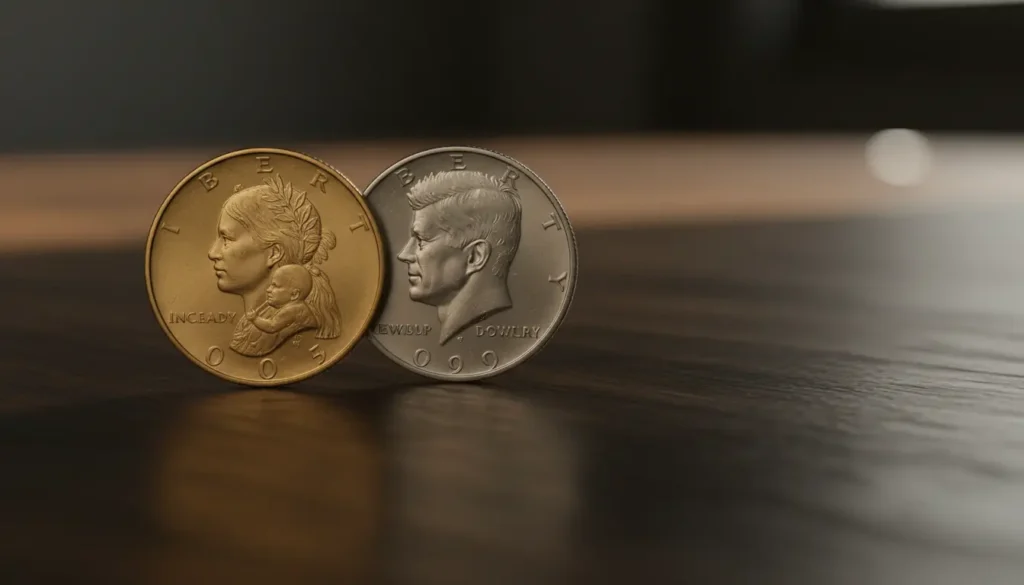
Choosing between a Sacagawea Dollar and a Kennedy Half Dollar depends on your goal: collecting, investing, gifting, or casual handling. This guide explains differences in history, composition, rarity, and practical buying tips so you can make a clear decision.
Sacagawea Dollar vs Kennedy Half Dollar Quick Comparison
The Sacagawea Dollar debuted in 2000 as a golden-colored dollar intended for everyday use and collectors. The Kennedy Half Dollar dates from 1964 and is most famous for its silver content in early issues and its Kennedy portrait.
- Face value: Sacagawea = $1; Kennedy Half = $0.50.
- Primary uses: Sacagawea for circulation and modern collecting; Kennedy for collecting and silver investment (older issues).
- Metal interest: Many Kennedy halves include silver in 1964 (90%) and 1965–1970 (40%); Sacagawea coins are clad manganese-brass with no precious metal.
Design and History of Sacagawea Dollar
The obverse of the Sacagawea Dollar features the Shoshone guide Sacagawea carrying her infant son. The reverse originally showed an eagle and later featured state and national designs for the Dollar Coin Program.
Sacagawea dollars were created to replace the Susan B. Anthony dollar and to encourage dollar coin use. They are modern, broadly available, and popular with novice collectors.
Design and History of Kennedy Half Dollar
The Kennedy Half Dollar honors President John F. Kennedy and was first issued in 1964 shortly after his assassination. The design has been mostly stable with minor changes for special issues and commemoratives.
Its early popularity and silver content make certain Kennedy halves attractive to both collectors and investors interested in precious metals.
Composition and Size: Know the Metals
- Sacagawea Dollar: manganese-brass clad, about 8.1 grams, 26.5 mm diameter. No silver content.
- Kennedy Half Dollar: 1964 issues are 90% silver; 1965–1970 are 40% silver; 1971 and later are copper-nickel clad. Diameter ~30.6 mm, weight varies by composition.
Metal composition affects intrinsic (melt) value and collector demand. If silver value matters, check the Kennedy’s date and mint mark before buying.
Value and Collectibility
Neither coin is guaranteed to appreciate, but values vary by date, mint mark, condition, and whether the coin is a proof or special issue.
- High-value Kennedy halves: 1964 90% silver in uncirculated or certified grades, and certain rare mint errors or low-mintage proofs.
- High-value Sacagawea dollars: Some 2000-P or 2000-D varieties, golden dollar errors, and high-grade proof or mint sets can command premiums.
Generally, older silver Kennedy halves have more intrinsic metal value, while Sacagawea dollars hold appeal for modern collectors and thematic sets.
How to Choose the Right Coin: Practical Checklist
Answer the following to pick the coin that fits your goal. Be realistic about budget and long-term intent.
- Purpose: Are you collecting a series, investing in silver, or buying a gift? Choose Kennedy for silver exposure and Sacagawea for modern series completion.
- Budget: Sacagawea dollars are inexpensive for circulated examples. Silver Kennedys cost more when priced near spot silver.
- Rarity and Date: Check mintages and known rare dates. Prioritize certified examples for valuable dates.
- Condition: Grading matters. Uncirculated or slabbed coins add cost but increase resale confidence.
- Storage: Silver requires specific care to avoid tarnish. Modern clad coins are low maintenance.
Examples of Use Cases
- Beginner collector: Start a Sacagawea series—affordable, many varieties, easy to source.
- Silver investor: Buy 1964 Kennedy halves or 1965–1970 40% silver halves for metal exposure.
- Gift or novelty: Sacagawea dollar looks distinct and is an easy, symbolic gift.
Some Kennedy Half Dollars from 1965–1970 contain 40% silver while 1964 coins are 90% silver. Sacagawea Dollars contain no silver and were designed for everyday use and collectors.
Buying Tips and Authentication
Buy from reputable dealers, auction houses, or certified marketplaces. For higher-value purchases, insist on third-party grading from services such as PCGS or NGC.
- Check for common errors that increase value, such as double dies or minting anomalies.
- Compare prices against silver spot price for Kennedy halves with silver content.
- Ask for return policies and guarantees when buying online or at shows.
Storage and Care
Store coins in acid-free holders or inert plastic flips. Silver coins should be kept dry to limit toning. High-value coins benefit from sealed slabs or capsules.
Label holdings with date, mint mark, grade, and purchase price for easier tracking and insurance purposes.
Real-World Example: A Short Case Study
Emma wanted a small coin collection and had $250. She considered a set of 10 Sacagawea dollars or a few Kennedy halves. Emma chose two certified 1964 Kennedy halves (90% silver) totaling $120 and 65 Sacagawea dollars for $130.
After three years, the Kennedy halves tracked silver prices and provided a small metal hedge, while the Sacagawea set preserved her interest in modern coinage and offered more display variety. Her mixed approach matched her goals: some silver exposure and a themed collection for enjoyment.
Bottom Line: Which Coin Should You Choose?
If you want silver value or long-standing collector demand, seek Kennedy Half Dollars from 1964–1970 with attention to silver content and condition. If you want an affordable, modern series or a visual, thematic collection, Sacagawea Dollars are practical and attractive.
Use the checklist above, verify dates and mint marks, and buy from trusted sources. That approach will help you choose the right coin for collecting, investing, or gifting.