
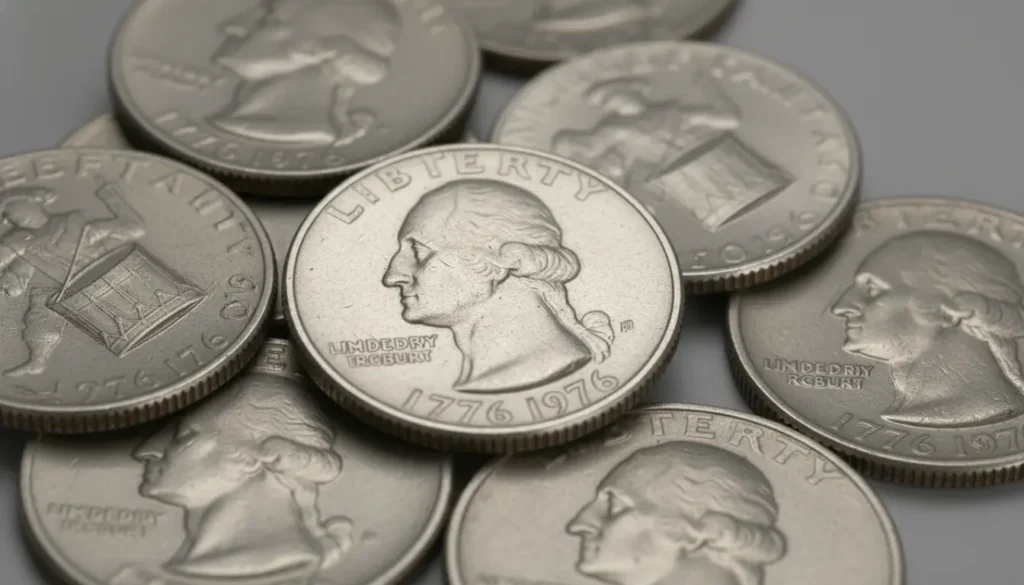
Understanding the Bicentennial quarter market
The 1776–1976 bicentennial quarter was produced in huge numbers for circulation and for mint sets. Because so many were made, most Bicentennial quarters have modest collector value unless they show a clear error or are in exceptional condition.
Online posts sometimes claim certain Bicentennial quarters are worth $2.5 million. Those headlines are almost always misleading. This article separates common myths from realistic possibilities and explains how to evaluate your coin.
5 coins often named in millionaire claims
Below are five types of Bicentennial quarters that frequently appear in viral posts. For each type we state the myth, the likely reality, and what to look for.
1. Alleged 1976 Double Die Obverse or Reverse
Myth: A double-die Bicentennial quarter is worth millions. Reality: Authentic double-die varieties exist but most modern double-dies are modestly valuable, not worth millions. High-grade, dramatic doubling graded by PCGS or NGC can attract collector bids into the hundreds or low thousands.
What to look for: Clear, repeated doubling on letters or numbers, not just machine-irrelevant doubling or die deterioration.
2. Off-Center Strikes and Severe Errors
Myth: Any off-center quarter is a treasure. Reality: Off-center errors can be valuable, but value depends on how far off-center, whether key details remain, and market demand. Small offsets are often only worth face value plus a small premium; large, dramatic offsets that preserve much of the design are the most desirable.
What to look for: Measure how much of the design is missing and confirm the coin is an actual off-center strike and not post-mint damage.
3. Wrong Planchet or Rare Metal Composition
Myth: A Bicentennial quarter struck on an unusual metal planchet (silver or gold) is worth millions. Reality: Genuine mules or wrong-planchet errors do occur but are extremely rare and must be authenticated. Most circulated quarters are the standard copper-nickel clad; claims of silver or gold Bicentennial quarters are almost always misidentifications or hoaxes.
What to look for: Unusual color, weight, and professional testing. Do not clean the coin—cleaning destroys value.
4. Proof Varieties with Deep Cameo or Exceptional Grade
Myth: A proof Bicentennial quarter with deep cameo automatically reaches six figures. Reality: High-grade proof coins with cameo contrast can be valuable to collectors, but prices typically range from tens to a few hundreds or low thousands, depending on grade and rarity—not millions.
What to look for: Sharp fields and devices, strong contrast, and an official grade from a reputable service.
5. Hoaxed or Misattributed Coins
Myth: If a source says a quarter sold for $2.5 million, your coin could be the same. Reality: Many viral claims lack provenance, auction records, or grading documentation. Always verify sales through recognized auction houses or grading company records before accepting extraordinary price claims.
What to look for: Auction certificates, graded population reports, and independent verification from PCGS/NGC sale databases.
How to examine your Bicentennial quarter
Follow these practical steps before you get excited or list a coin for sale. Proper initial evaluation prevents mistakes and protects value.
- Do not clean the coin or use abrasive tools.
- Check the mint mark (none for Philadelphia, D for Denver, S for San Francisco) near the truncation of Washington’s hair.
- Compare to reference images for doubling, die cracks, or unusual features.
- Weigh the coin and check diameter if you suspect a wrong planchet.
- Take clear photos (obverse, reverse, close-ups) under neutral light.
What to do if you think your coin is valuable
If your preliminary check suggests an unusual error or exceptional grade, follow these steps to protect and potentially monetize the coin.
- Keep the coin in a holder—avoid PVC and household storage that can damage it.
- Get a second opinion from a reputable coin dealer or local coin club.
- Consider professional grading with PCGS or NGC if the coin appears to be a major error or extremely high grade.
- Document provenance and any auction history before listing the coin for sale.
The Bicentennial quarter reverse, showing a colonial drummer with a torch encircled by 13 stars, was designed by Jack L. Ahr. The coins were minted in 1975 and 1976 and all carry the dual date 1776–1976.
Real-world example: a cautious success
A collector found a Bicentennial quarter in circulation with a noticeable off-center strike. After photographing and consulting a regional dealer, the piece was authenticated as a genuine mint error. The coin sold privately for several hundred dollars—well above face value but far below the viral million-dollar claims.
That example is typical: real value exists for authentic errors, but prices are proportional to rarity and condition, not to sensational headlines.
Quick checklist before you believe a million-dollar claim
- Is there a verifiable auction record or graded certificate?
- Has the coin been professionally authenticated?
- Does multiple expert opinion agree on the rarity?
- Was the coin altered or cleaned (which lowers value)?
Final advice: realistic expectations and careful steps
Most Bicentennial quarters are common and worth little more than face value unless they display a clear, authenticated error or exist in exceptional, certified condition. Treat sensational online claims skeptically and follow methodical steps to verify any unusual find.
If you think you have a rare Bicentennial quarter, document it, seek reputable opinions, and consider professional grading. That will give you the best chance of a fair market outcome.