
Roosevelt Dime vs Sacagawea Dollar: Quick overview
The Roosevelt dime and the Sacagawea dollar are everyday U.S. coins with different roles in circulation and collecting. This guide explains how to identify each coin, compares their physical and historical differences, and gives practical tips for collectors and casual holders.
Basic identification: Roosevelt Dime vs Sacagawea Dollar
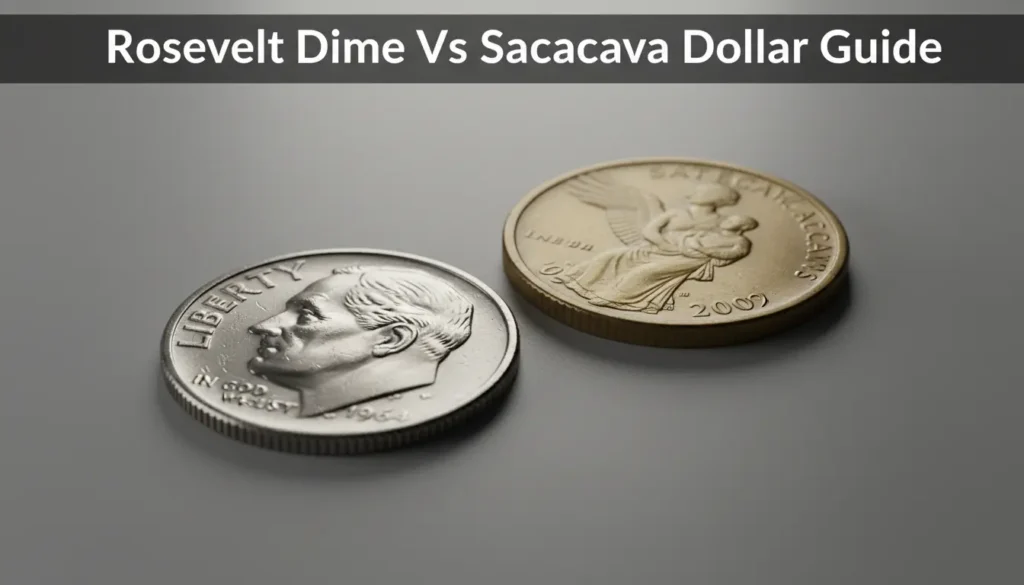
The Roosevelt dime is a small silver-colored coin first minted in 1946, featuring President Franklin D. Roosevelt on the obverse. The Sacagawea dollar debuted in 2000 and is a larger golden-colored dollar coin with Sacagawea and her child on the obverse.
Key visible traits to check:
- Size and color: Dime is small and silver; dollar is larger and gold-toned.
- Edge: Roosevelt dimes have reeded edges; Sacagawea dollars have smooth edges (later Native American dollar issues may have edge lettering).
- Denomination marking: Dollar coins clearly state ONE DOLLAR; dimes show the FACE value by size and the word DIME on some designs.
Roosevelt Dime physical specs
Modern Roosevelt dimes (post-1965) are composed of a copper core with a copper-nickel cladding. The coin measures 17.91 mm in diameter and weighs 2.27 grams.
Pre-1965 dimes are silver (90% silver, 10% copper) and are sought after by collectors for their silver content and potential numismatic value.
Sacagawea Dollar physical specs
The Sacagawea dollar is 26.5 mm in diameter and weighs 8.1 grams. It is a manganese-brass clad composition that gives a golden color. The coin’s smooth edge and size make it easy to distinguish from other U.S. coins.
Note: The Sacagawea dollar design was followed by the Native American $1 series, which changes reverse designs annually but keeps the obverse or a similar obverse image.
Design and historical differences
The Roosevelt dime honors the late president and was introduced to commemorate FDR shortly after his death. The Sacagawea dollar honors the Shoshone guide Sacagawea and aimed to revive interest in dollar coins for everyday use.
- Roosevelt dime obverse: Portrait of FDR; reverse: torch, oak and olive branches.
- Sacagawea dollar obverse: Sacagawea carrying her infant; reverse: originally an eagle in flight, later changing annually for the Native American series.
Value and rarity: What matters most
Most modern Roosevelt dimes and Sacagawea dollars are worth face value in circulation. Value increases based on silver content, mint errors, low mintage dates, or high grade condition.
Factors that affect value:
- Metal content: Pre-1965 dimes have intrinsic silver value.
- Mintage and demand: Low mintage dates or proof strikes can carry a premium.
- Condition: Uncirculated or high-grade coins are worth more to collectors.
- Errors: Double dies, off-center strikes, or planchet errors can be valuable.
Examples of potentially valuable coins
- 1955-S Roosevelt Dime in high grade may be sought by specialists.
- 2000 Sacagawea dollar with rare errors, like misplaced mint marks or double strikes, can fetch collector prices.
Roosevelt dimes minted before 1965 contain 90% silver. Those coins are worth at least their melt value, which often exceeds ten times the face value of 10 cents when silver prices rise.
Practical identification tips for collectors
When you find a dime or dollar in pocket change or a roll, use a simple checklist to decide if it should be set aside for further inspection.
- Check the date and mint mark. Pre-1965 dimes are silver and should be saved by default.
- Inspect edges for reeding or lettering; unusual edges often indicate a special issue or error.
- Compare weight and diameter with reference charts if you suspect a counterfeit.
- Use a loupe to examine strike quality, doubling, or die cracks.
Tools to keep on hand
- Handheld scale (0.01 g accuracy).
- Magnifying loupe (10x to 20x).
- Reference guidebook or online price guide for recent auction results.
Case study: Finding value in circulation
In 2023, a casual collector bought a box of mixed coins from a local bank. While sorting, they found a Sacagawea dollar with a faint doubled die on the reverse. After grading by a local coin dealer, the coin sold for several hundred dollars—far above face value.
This example shows that checking for errors and keeping a basic toolkit can turn everyday change into collectible finds.
Buying and selling tips for Roosevelt Dime vs Sacagawea Dollar
If you plan to buy or sell, work with reputable dealers or online marketplaces with good feedback. For higher-value pieces, consider third-party grading (PCGS, NGC) to establish provenance and grade.
Pricing guidance:
- Common circulated Roosevelt dimes: typically worth face value unless silver or error.
- Sacagawea dollars: often traded at or near face value unless rare error or proof specimens.
Summary and quick action steps
Roosevelt dimes and Sacagawea dollars are easy to tell apart by size, color, and edge type. Most remain face-value coins, but silver content, errors, and condition can add value.
Quick checklist to follow when you find a coin:
- Note date and mint mark.
- Look for unusual edges or doubling.
- Weigh and measure if you suspect a nonstandard composition.
- Consult a price guide or dealer for suspicious finds.
Following these practical steps will help you confidently assess Roosevelt dimes and Sacagawea dollars and spot coins worth further attention.