
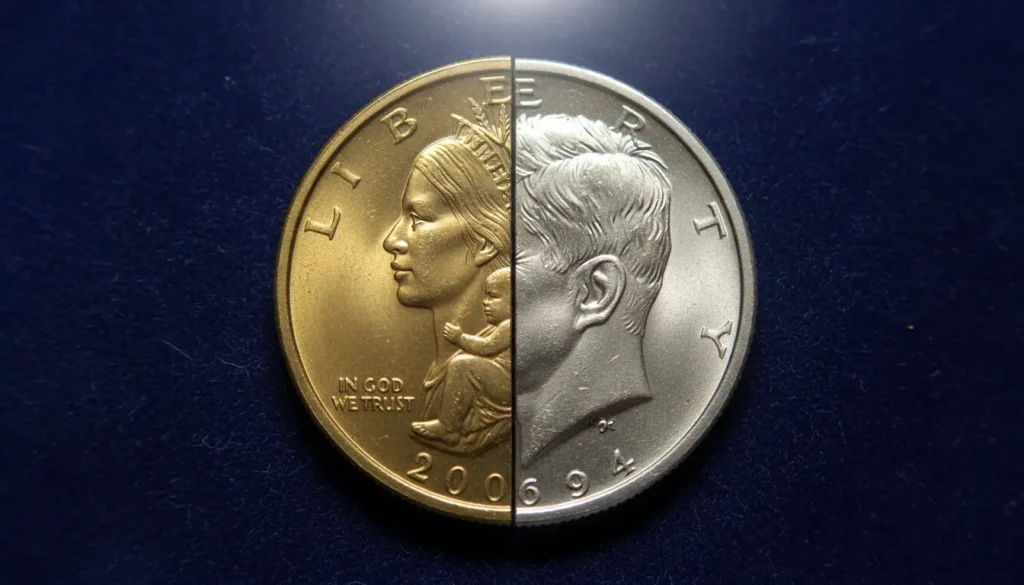
Sacagawea Dollar vs Kennedy Half Dollar: Key Differences
When choosing between the Sacagawea Dollar and the Kennedy Half Dollar, focus on purpose first. Are you buying to spend, collect, or invest? The right choice depends on size, metal content, rarity, and budget.
Design and Composition of Sacagawea Dollar
The Sacagawea Dollar was introduced in 2000 as a modern one-dollar coin. It has a copper core plated with manganese-brass giving it a golden color.
Key traits include a 26.5 mm diameter, smooth edge, and a lightweight feel. Most dates are common and inexpensive for collectors.
Design and Composition of Kennedy Half Dollar
The Kennedy Half Dollar debuted in 1964 and honors President John F. Kennedy. Early issues contain silver: 1964 is 90% silver and 1965–1970 are 40% silver.
Post-1970 pieces are copper-nickel clad with a larger 30.6 mm diameter and a reeded edge. Kennedy halves carry more historical appeal for many collectors.
Value, Rarity, and Market Considerations
Value varies widely across both coin types. Most Sacagawea Dollars in circulation trade at face value. Special proofs or error coins command higher prices.
Kennedy Half Dollars show a wider value spread because of silver content and older mintages. A 1964 Kennedy often trades above face value because of its 90% silver content.
Typical Price Ranges
- Sacagawea Dollar: Common circulated coins usually near $1. Uncirculated or proof examples may fetch $2–$50 depending on condition and demand.
- Kennedy Half Dollar: 1964 pieces often trade near silver melt value. 1965–1970 40% silver pieces have value tied to silver price. Post-1970 common halves often trade close to face value unless in high grade or special mint sets.
How to Choose the Right Coin: Practical Steps
Follow a simple decision process to pick the coin that suits your goals. Consider metal content, collectibility, storage, and liquidity.
Step 1: Define Your Goal
Collecting for fun: Choose the coin that appeals to you visually or historically. Budget-focused collecting: prioritize common but high-grade examples.
Investing: prefer silver Kennedy halves (1964 or 1965–1970) if you want metal value exposure. Sacagawea Dollars are not a silver investment vehicle.
Step 2: Check Condition and Grade
Condition is the single biggest factor after rarity. Look for coins with minimal wear and clear details. Professional grading raises costs but can simplify verification.
For beginners, learn to assess strike, luster, and surface marks. Use a 10x loupe and compare to reference photos before buying.
Step 3: Verify Rarity and Market Demand
Use price guides, auction results, and dealer listings to confirm typical prices for your coin and grade. Rare dates and mint marks can change the choice quickly.
Also consider demand — popular series sell faster and are easier to resell.
Practical Pros and Cons
- Sacagawea Dollar
- Pros: Lightweight, modern design, affordable entry cost.
- Cons: Most lack precious metal content; limited investment upside.
- Kennedy Half Dollar
- Pros: Historical appeal, some issues contain silver which holds intrinsic value.
- Cons: Larger size needs more storage space; many modern coins trade near face value.
Storage, Display, and Handling
Both coins benefit from simple protective measures. Use coin flips, holders, or albums to prevent scratches and contact with skin oils.
Store in a dry, temperature-stable environment away from PVC plastics. Label each coin with date and grade to keep track of provenance.
The Sacagawea Dollar is sometimes called the Golden Dollar because of its color, but it contains no gold. Early Kennedy Half Dollars were struck in 90% silver, a major draw for collectors today.
Real-World Example: Case Study
Emma, a new collector, had $200 to start a collection. She liked both coins but used goals to decide. For diversity, she bought:
- Five Sacagawea Dollars in uncirculated condition at $2 each for aesthetic display and low risk.
- Two Kennedy Half Dollars: one 1964 (90% silver) purchased at $20 and one 1972 uncirculated modern half at $3.
After a year, the 1964 half tracked with silver prices and held intrinsic value. The Sacagawea pieces remained stable and attractive in her album. This balanced approach matched her collecting and mild investment goals.
Final Recommendation: Match Coin to Goal
If you want metal value and historical depth, prioritize Kennedy Half Dollars from silver years. If your priority is a low-cost, modern series that looks good in a collection, choose Sacagawea Dollars.
For many collectors, a mix of both series is sensible. Start small, research specific dates, and focus on condition to build a collection that you enjoy and can resell if needed.
Quick Checklist Before Buying
- Decide purpose: collect, invest, or gift.
- Check metal content and mint year.
- Assess coin condition and verify authenticity.
- Compare prices from multiple dealers or auction sites.
- Plan storage and labeling for long-term preservation.
Choosing between the Sacagawea Dollar and the Kennedy Half Dollar becomes straightforward when you prioritize your goals and verify condition. Use the checklist above and start with a small, informed purchase to learn the market.