
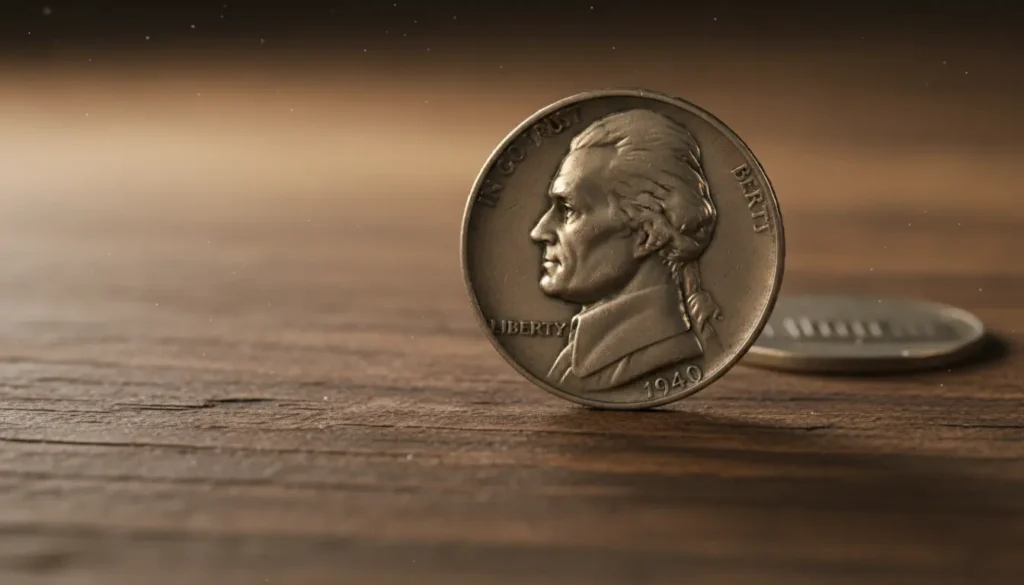
The Jefferson nickel minted during World War II stands out in American numismatics. Changes in metal content, minting location marks, and a handful of rare varieties turned some war-era nickels into high-value collector pieces.
Why the War-Era Jefferson Nickel Matters
The term “war-era Jefferson nickel” generally refers to nickels struck from mid-1942 through 1945. These coins are easy to identify and have distinct historical and material reasons for their value.
Collectors prize them for three main reasons: different metal composition, visible mint-mark changes, and the presence of errors and scarce high-grade survivors.
War-Era Jefferson Nickel: The composition change
Beginning in 1942, nickel metal was redirected to the war effort. The U.S. Mint switched the Jefferson nickel alloy to a silver-bearing composition of 35% silver, 56% copper, and 9% manganese.
That silver content gives these nickels intrinsic metal value and a distinct look compared with standard cupro-nickel coins. The alloy also affected strike and toning, which can help graders and collectors verify authenticity.
Mint mark and design identifiers
Another clear identifier of a war-era Jefferson nickel is the mint mark placement. From 1942 through 1945 the mint mark was moved to the reverse, above Monticello. This change makes genuine war nickels easy to spot at a glance.
Knowing where to look for the mint mark is a practical first step for beginners assessing a coin’s identity and potential value.
How the War-Era Jefferson Nickel Gained Value
Value rises when rarity, demand, and historical interest intersect. In the case of the war nickel, each of these factors plays a role.
High-grade survivors and certain mint errors are scarce because many circulated heavily during and after the war. That scarcity attracts collectors and investors.
Scarcity and survival rates
Millions of war nickels were produced, but most saw circulation and wear. Coins with original luster and full detail—especially those graded Mint State (MS) by professional services—are uncommon and command premiums.
Collectors look for sharp details on Jefferson and clear mint marks above Monticello to identify high-grade war nickels.
Errors and varieties that raise premiums
Error coins and unusual varieties—like repunched mint marks, double dies, or misplaced mint indicators—can be far more valuable than ordinary specimens. Even minor doubling or repunching is closely studied by specialists.
Because the mint changed dies and processes during wartime, a handful of unusual die states and mistakes slipped into production and are now collectible.
- Silver content gives baseline intrinsic value.
- Mint mark above Monticello is a quick identifier.
- Errors, repunched mint marks, and high MS grades multiply interest.
Practical Steps to Identify a War-Era Jefferson Nickel
Follow a simple checklist to evaluate a suspected war nickel. A systematic approach reduces mistakes and helps you decide whether to get professional grading or appraisal.
Checklist for quick evaluation
- Look for the date: 1942, 1943, 1944, or 1945.
- Check the reverse above Monticello for a mint mark (P, D, or S).
- Inspect the surface: silver alloy often shows lighter, satiny luster and different toning.
- Assess detail on Jefferson and Monticello—sharper detail suggests higher grade and value.
- Look for obvious errors: doubled dies, repunched mint marks, or die cracks.
Protecting and Selling War-Era Jefferson Nickels
If you suspect you have a valuable war nickel, handle it carefully and avoid cleaning. Cleaning can remove original surfaces and destroy value.
For potentially valuable pieces, consider third-party grading by services like PCGS or NGC. A professional grade and authentication often unlocks market value and buyer confidence.
Where to sell or appraise
Use reputable auction houses, specialist coin dealers, or graded coin marketplaces for selling. Get multiple opinions if a coin appears rare or unusual.
Documentation, provenance, and high-quality photos help attract serious buyers and justify asking prices.
Case Study: A Small Real-World Example
A retired teacher found a 1943 nickel at a local estate sale, dated and bearing a mint mark above Monticello. Initially priced like pocket change, the coin showed strong luster and detailed rims.
After a knowledgeable dealer suggested grading, the coin was slabbed with a high Mint State grade. The authenticated grade and silver composition turned a common purchase into a coin that sold for several thousand dollars at auction to a Jefferson nickel specialist.
That example shows the practical path from discovery to value: identify war-era features, avoid cleaning, get an expert opinion, and consider professional grading before selling.
Conclusion
The war-era Jefferson nickel is a strong example of how material changes, minting differences, and collector demand create value. By learning the key identifiers—silver alloy, mint mark location, and common error types—you can spot candidates worth further study.
Start with the simple checklist, protect original surfaces, and use reputable graders and dealers to confirm and realize value from a war-era Jefferson nickel.